Modern Infrastructure
Stronger systems with up-to-date technologies.

High Performance
More efficient systems with increased production capacity.

Reliable Operation
Minimum risk of failure and continuous production.

Low Cost
High energy efficiency and cost savings.
Modernization Approach
Automation systems used in industrial facilities may require updates over time due to evolving technology, rising performance expectations, and new integration needs. In this context, modernization offers a strategic approach that transforms existing systems into a more efficient and sustainable structure while preserving the infrastructure, rather than replacing it entirely.
With properly planned modernization processes, production continuity is preserved, system reliability is improved, and businesses are prepared for the future with a stronger infrastructure.
Our Modernization Process
System Analysis and Current Infrastructure Assessment
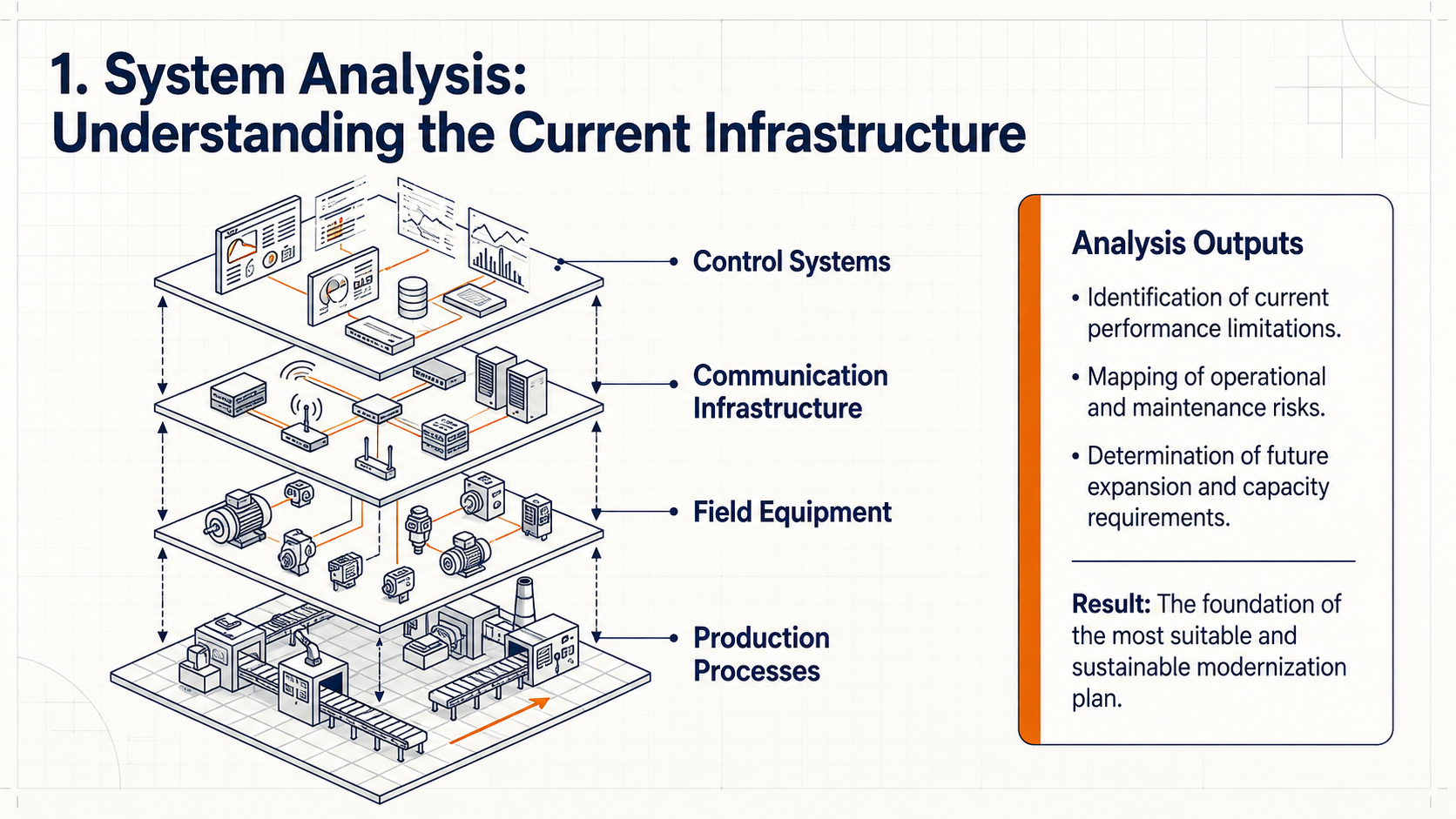
The first step in the modernization process is a detailed assessment of the existing automation infrastructure. Control systems, field equipment, communication structure, and production processes are analyzed from both technical and operational perspectives to establish the current performance level. Based on this assessment, performance limitations, maintenance risks, capacity needs, and future expansion requirements are identified. Using the data obtained, a sustainable modernization plan best suited to the business is developed.
Detailed Analysis
Performance Analysis
Infrastructure Review
Issue and Risk Identification
Modernization Strategy and Planning
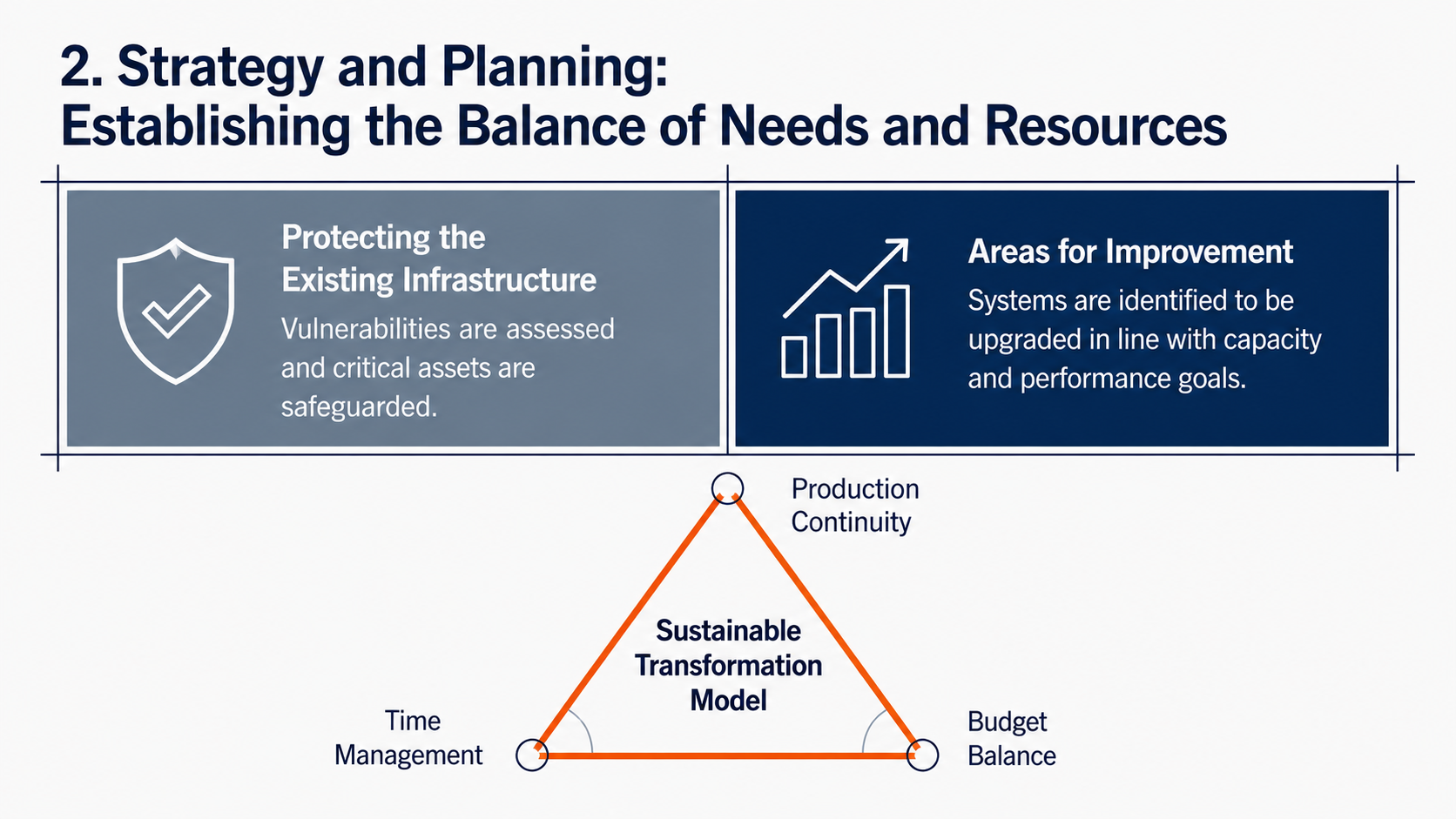
Following the detailed analysis, a modernization strategy is developed based on the business’s production structure, capacity goals, and technical needs. While evaluating which parts of the existing infrastructure can be preserved, the areas requiring renewal are clearly identified.
During the planning process, a controlled transformation model is prepared based on production continuity, time management, and budget balance.
Modernization Strategy
Current System Analysis
Control Model Development
Process Management
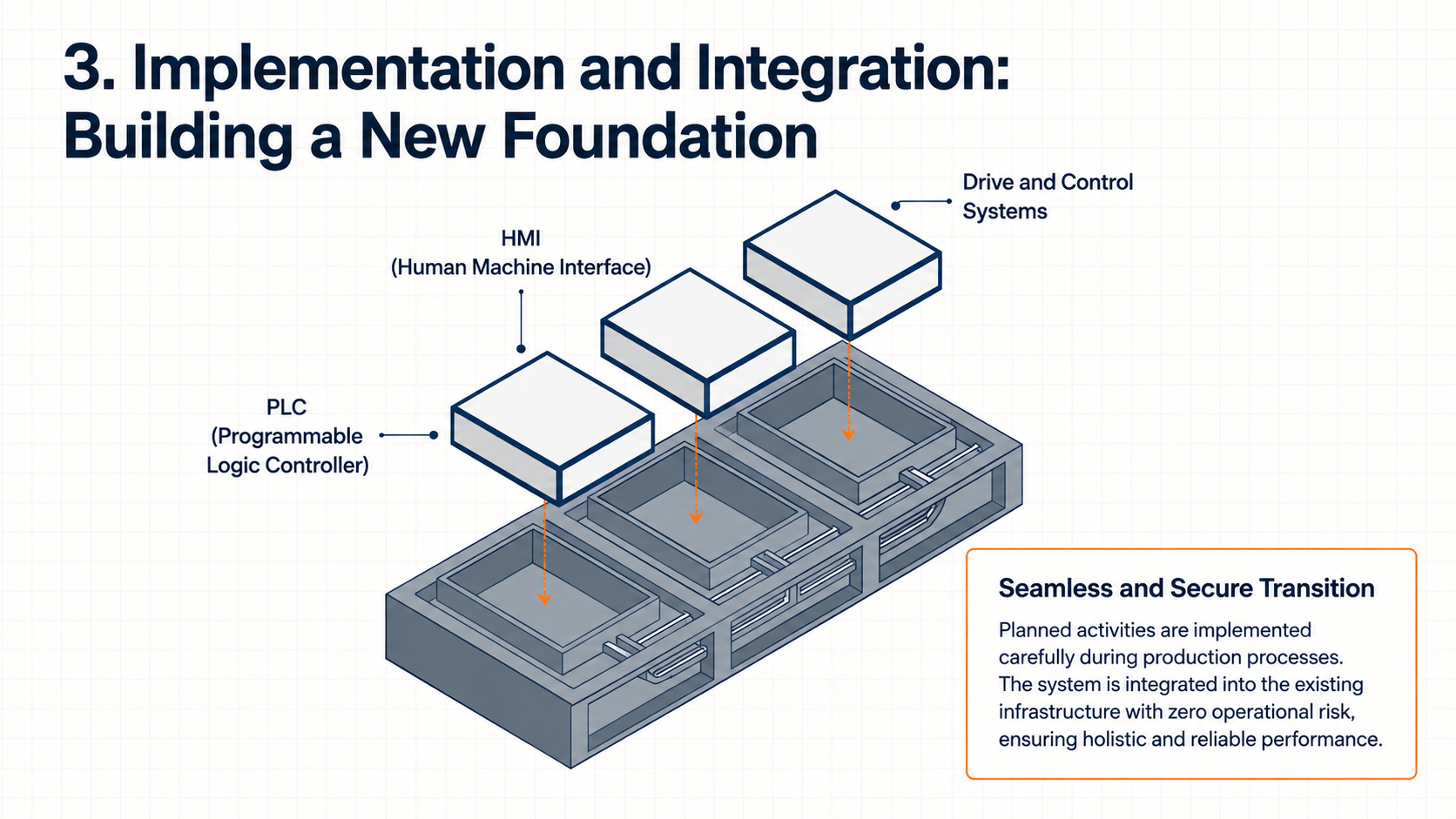
Implementation and Integration
Planned modernization activities are carried out in a controlled manner with careful consideration of ongoing production processes. While next-generation automation components are integrated into the existing infrastructure, the transition is managed to ensure uninterrupted and safe operation. PLC, HMI, drive, and control systems are commissioned and integrated to ensure reliable, seamless, and efficient system performance.
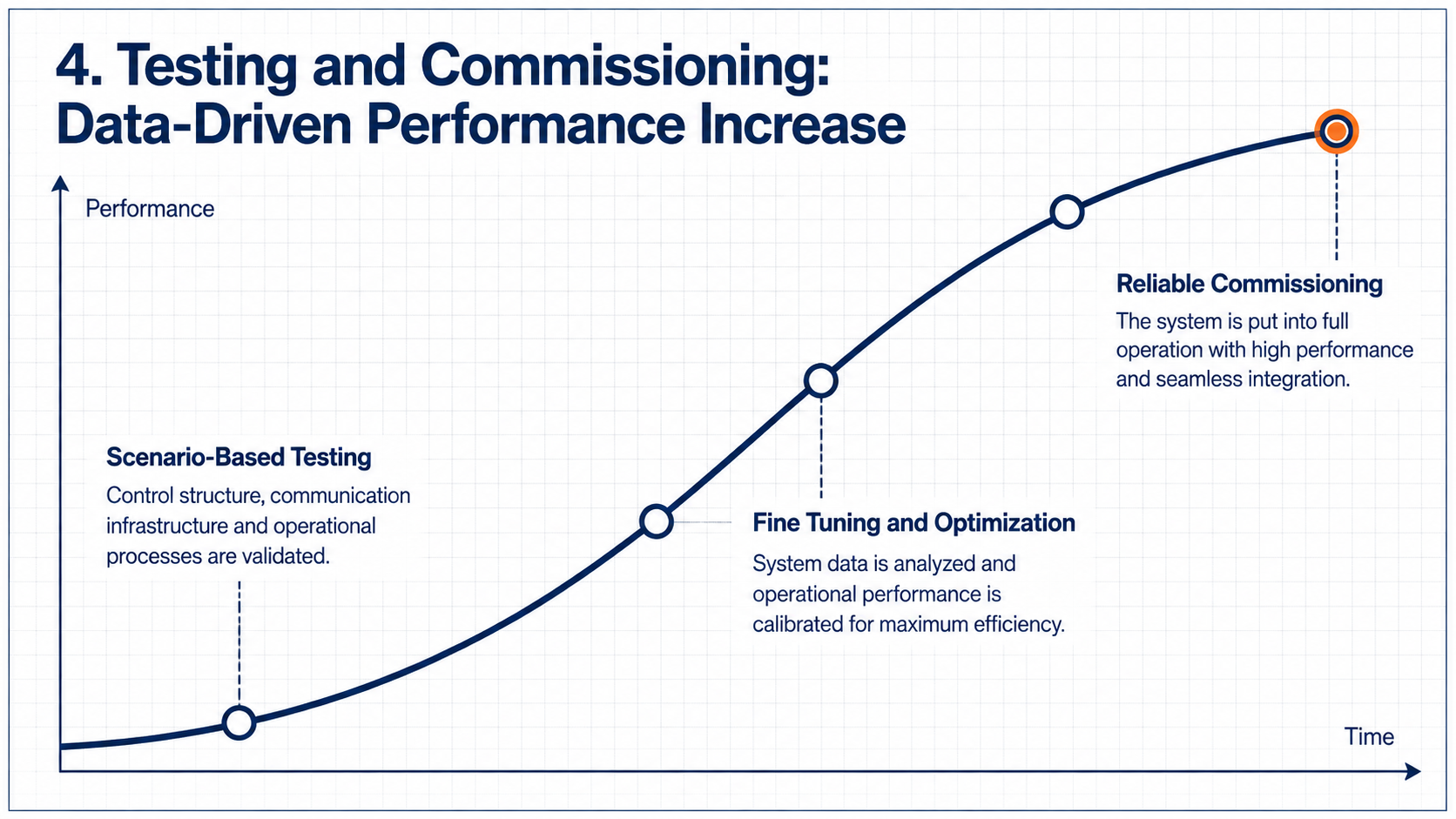
Following implementation, the system is tested under defined operating scenarios to verify the control architecture, communication infrastructure, and operational processes. After the necessary optimizations are completed, the system is safely commissioned to ensure reliable, stable, and high-performance operation.
System Integration
Safe Transition Process
Optimization Testing
Commissioning
Result and Solution Approach
Modernization work is not merely about renewing existing systems — it is a process of building a more efficient, reliable, and sustainable structure while preserving production continuity. Each project is treated not as a standard implementation, but as an engineering solution tailored to the specific needs of the business.
The goal of this approach is not just to update the system, but to create a flexible, future-ready automation infrastructure that adds long-term value to the business.
Throughout the process, the steps of analysis, planning, implementation, and commissioning are managed in a controlled manner, with the aim of achieving maximum efficiency. Every solution is shaped and brought to life through strong engineering insight combined with real field experience.
The Value Modernization Delivers
Properly planned modernization efforts improve the performance of existing systems while providing businesses with significant operational and economic advantages.
Sample Projects
In modernization projects carried out across different sectors, numerous applications aimed at improving the performance of existing systems have been successfully completed. The examples below reflect a solution approach shaped by field experience.


A machine with a 12-axis ELAU servo motor and drive infrastructure has been modernized with next-generation Schneider Electric motion control solutions.
The synchronously operating multi-axis structure was reconfigured, improving system performance and control stability.
Thanks to a conversion carried out while preserving mechanical compatibility, a fast transition was achieved without the need for additional mechanical revisions, and the commissioning process was completed with minimal downtime.